

Time:2025-12-16 Views:0
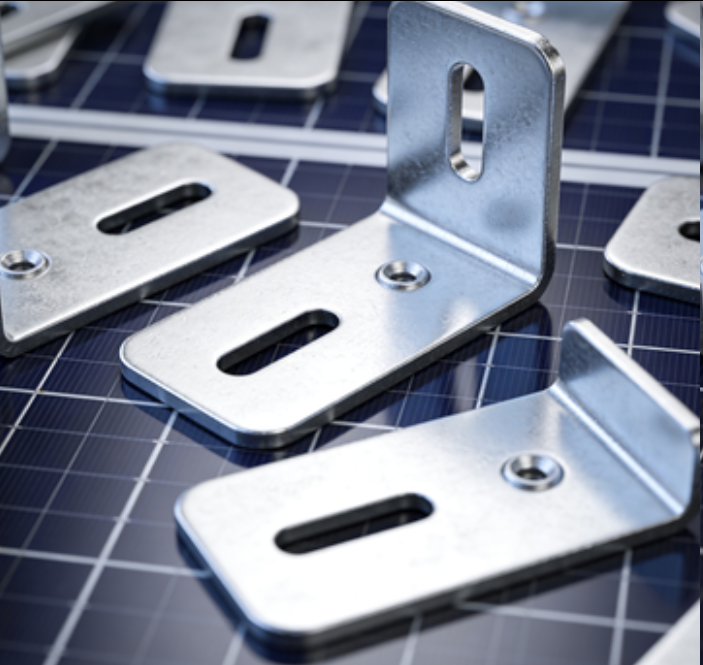
Stamping parts play a pivotal role in the manufacturing of solar bracket plates, which are critical components for securing solar panels to rooftops, ground-mounted systems, or tracking structures. Solar bracket plates require high structural strength, corrosion resistance, and precise dimensional accuracy to withstand outdoor environmental stressors—such as wind loads, temperature fluctuations, and UV exposure—while maintaining the stability of solar panels over their 25–30 year lifespan. Stamping technology, with its ability to produce high-volume, consistent, and cost-effective parts, is ideally suited to meet these demands.
The manufacturing process of solar bracket plates using stamping involves several key steps. First, high-quality metal sheets—typically aluminum alloy (e.g., 6061-T6) or galvanized steel—are selected for their lightweight, corrosion-resistant, and high-tensile strength properties. Aluminum alloy is preferred for rooftop systems due to its low weight (reducing roof load) and natural oxide layer that resists rust, while galvanized steel is used for ground-mounted systems where greater load-bearing capacity is required. The metal sheets are then fed into precision stamping presses, where custom dies cut, bend, and form the material into specific shapes—such as mounting holes, grooves for panel edges, and reinforcement ribs. Stamping ensures that each bracket plate has uniform dimensions (with tolerances as tight as ±0.1mm), which is critical for easy on-site assembly and alignment of solar panels.
One of the key advantages of stamping for solar bracket plates is its ability to create complex structural features that enhance strength without adding weight. For example, stamping can form integrated reinforcement ribs along the length of the bracket plate, increasing its bending resistance by 30–50% compared to flat plates. This is essential for withstanding wind speeds of up to 120 mph (common in coastal or windy regions) and snow loads of 20–30 lbs/sq ft (in cold climates). Additionally, stamping can produce precise mounting holes (e.g., M8 or M10 threaded holes) that align perfectly with solar panel frames and fasteners, eliminating the need for secondary drilling or tapping and reducing assembly time on-site.
Corrosion resistance is another critical requirement for solar bracket plates, and stamping supports this through compatibility with post-processing treatments. After stamping, bracket plates can undergo surface treatments like anodizing (for aluminum) or powder coating (for steel) to enhance their resistance to rain, salt spray (in coastal areas), and chemical pollutants. Stamping’s smooth surface finish ensures that these coatings adhere uniformly, providing long-lasting protection. For example, anodized aluminum bracket plates have a corrosion resistance rating of up to C5 (per ISO 12944), making them suitable for use in industrial or marine environments.
Cost-effectiveness is a major driver for using stamping in solar bracket plate production. Solar energy projects require thousands of bracket plates per installation, and stamping enables high-volume production (up to 10,000 parts per hour with automated lines) at a lower unit cost compared to other manufacturing methods like machining or welding. The use of custom dies also reduces material waste—stamping can achieve material utilization rates of 85–95%, minimizing scrap and lowering overall production costs. This cost efficiency is critical for the solar industry, where reducing the cost of balance-of-system (BOS) components (like brackets) directly contributes to making solar energy more competitive with fossil fuels.
stamping parts for solar bracket plates combine structural integrity, corrosion resistance, precision, and cost-effectiveness—key factors for ensuring the reliability and affordability of solar energy systems. As the global demand for solar power continues to grow, stamping technology will remain a cornerstone in the production of high-quality solar bracket plates.
 China management center add.
204, Building A, Phase 3, Jiewei Industrial Park, Shangmugu Community, Pinghu Street, Longgang District, Shenzhen, China
 Headquarters tel.
+86 134 3077 5139
 E-mail.


 CN
CN


