

Time:2026-01-12 Views:0
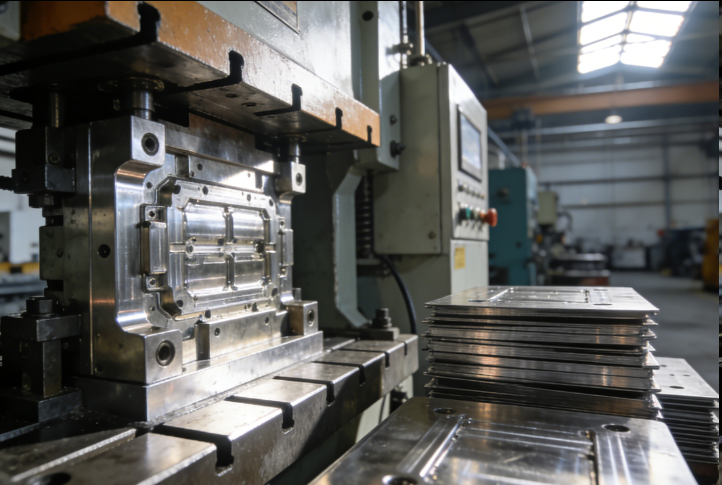
Stamping parts and fine blanking parts processing represents a sophisticated and highly precise manufacturing technique that plays a vital role in various industries. Stamping, as a fundamental metal - forming process, involves the use of dies and presses to shape flat metal sheets into desired forms. Fine blanking, a specialized subset of stamping, takes this process to the next level by producing parts with exceptional precision, smooth surfaces, and high - quality edges.
In the stamping process, a flat metal sheet, often made of materials like steel, aluminum, or copper, is placed between two dies. One die is fixed, while the other moves under the force of a press. As the press exerts pressure, the metal sheet is deformed, cut, or formed according to the shape of the dies. This process can create a wide range of parts, from simple brackets and housings to complex components used in automotive, aerospace, and electronics industries. Stamping is highly efficient, capable of producing large quantities of parts in a short time, which makes it cost - effective for mass production.
Fine blanking, on the other hand, is designed to achieve parts with superior dimensional accuracy and surface finish. It uses a unique combination of cutting, blanking, and forming operations in a single stroke. The key to fine blanking is the application of a precisely controlled blank - holder force, which clamps the metal sheet firmly between the die and the blank - holder. This prevents the metal from deforming in an unwanted way during the cutting process, resulting in parts with clean, burr - free edges and flat surfaces. Fine blanking parts often require no additional machining or finishing operations, saving both time and cost in the production process.
The processing of stamping parts and fine blanking parts requires advanced equipment and skilled operators. High - precision presses with accurate force control systems are essential for stamping, while fine blanking demands even more specialized presses with enhanced blank - holder force capabilities. Additionally, the design and manufacture of dies are critical aspects of the process. Dies need to be carefully engineered to match the part’s design requirements, and their quality directly affects the accuracy and quality of the final parts. With continuous advancements in technology, such as the use of computer - aided design (CAD) and computer - aided manufacturing (CAM) systems, stamping parts and fine blanking parts processing are becoming more efficient, precise, and capable of producing increasingly complex parts to meet the evolving needs of modern industries.
 China management center add.
204, Building A, Phase 3, Jiewei Industrial Park, Shangmugu Community, Pinghu Street, Longgang District, Shenzhen, China
 Headquarters tel.
+86 134 3077 5139
 E-mail.


 CN
CN


